Liposome nanoreactors enable colour tuning across RGB spectrum

Figure 1: Schematic illustration of the liposome-based nanoreactor (LNR) strategy for the controlled assembly of colour-tuneable luminescent nanomaterials in aqueous solution. Original artwork by Aaron Torres-Huerta.
Lanthanide-based hybrid nanomaterials are attracting interest for applications in advanced optical technologies, chemical sensing, and biomedical imaging due to their unique light-emitting properties. The resulting emission colour can be finely tuned by adjusting the proportion of lanthanide ions incorporated in the material. This tunability enables highly customizable optical responses to tackle specific applications. However, achieving precise control over chemical composition at nanometric scale in aqueous media remains a major scientific challenge.
The researchers addressed this challenge by using liposomes as tiny reaction vessels. Liposomes are spherical compartments surrounded by a lipid membrane similar to those found in living cells. The liposomes were first loaded with controlled amounts of terbium and europium ions, which can emit green and red light, respectively. A synthetic molecular transporter was then embedded in the membrane to carry an organic building block, benzene-1,4-dicarboxylate (BDC2–), into the liposomes. Once inside, the ligand coordinated with the lanthanide ions, forming luminescent nanomaterials. By simply varying the terbium-to-europium ratio, the researchers were able to fine-tune the colour of the emitted light across the green-yellow-orange-red range.
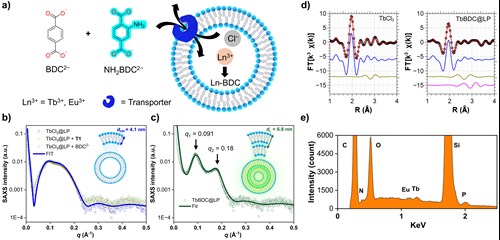
Figure 2: a) Controlled transmembrane transport of BDC2–/NH2BDC2– followed by coordination with Tb3+ and Eu3+ co-encapsulated inside liposomes. b) SAXS profiles of: TbCl3@LP (blue; fitted), TbCl3@LP + T1(orange) and TbCl3@LP + BDC2– (green). c) SAXS profile of TbBDC@LP. d) Tb LIII-edgeEXAFS spectra of TbCl3 and TbBDC@LP. e) Energy-dispersive X-ray spectroscopy (EDX) elemental analysis of Tb50Eu50BDC@LP sample. Panels a, d and e adapted from Cell Rep. Phys. Sci., 7, 5, 103312, 2026, licensed under CC BY 4.0. Panels b and c adapted from Angew. Chem. Int. Ed., 2025, 64, e202510471, licensed under CC BY 4.0.
“By treating liposomes as extremely small reaction vessels, we could control where the complexes formed and finely adjust the proportion of the two metals,” says Aaron Torres-Huerta. “This gives us a flexible way to design stable luminescent materials directly in water.”
Introducing a modified, blue-emitting version of BDC2–, known as NH2BDC2–, extended this colour control across the full red–green–blue colour space. Real-time emission measurements also showed that europium luminescence appeared more rapidly than terbium luminescence, providing insight into how the two lanthanide ions react under nanoscale confinement.
Through NFFA-Europe Transnational Access, the researchers complemented their optical measurements with small-angle X-ray scattering, X-ray absorption spectroscopy and electron microscopy combined with elemental analysis.
The liposome-based nanoreactor system offers a new way to investigate coordination chemistry in extremely small confined spaces and to engineer water-stable, multimetallic luminescent materials with finely tunable optical properties.
More broadly, the work shows how tiny lipid vesicles can be used as miniature reaction vessels to build complex materials in a highly controlled way. This approach could open new opportunities for designing functional materials with tailored optical properties for future sensing, imaging and photonic technologies.
A. Torres-Huerta, M. de J. Velásquez-Hernández, S. Lempereur, L. Troian-Gautier, G. Veronesi and H. Valkenier, “Color-tunable luminescent TbxEuy(BDC) complexes assembled within liposome-based nanoreactors,” Cell Rep. Phys. Sci., Volume 7, Issue 5, 103312, 2026. DOI: 10.1016/j.xcrp.2026.103312
A. Torres-Huerta, M. D. J. Velásquez-Hernández, E. Tamarit-Amoros, M. Raschetti, D. Pinkas, O. Jurček, J. Pérez and H. Valkenier, “Spatiotemporal Control of the Formation of Luminescent Lanthanide Complexes in Liposome-Based Nanoreactors,” Angew. Chem. Int. Ed., 2025, 64, e202510471. DOI: 10.1002/anie.202510471
These studies were supported through NFFA-Europe Pilot Transnational Access (proposal ID520) and involved measurements at two NFFA-Europe facilities.
At the SAMBA and SWING beamlines of Synchrotron SOLEIL, the researchers used terbium LIII-edge X-ray absorption spectroscopy and small-angle X-ray scattering (SAXS) to investigate the formation of the luminescent materials. X-ray absorption spectroscopy, including XANES and EXAFS, provided element-specific information on the chemical state and local atomic environment of terbium. Meanwhile, time-resolved SAXS revealed that complex formation generated osmotic pressure changes, triggering a structural transformation of the liposomes from unilamellar to bilamellar vesicles.
At ENL FEMTO-ST/CNRS–EuroNanoLab, the researchers used scanning electron microscopy coupled with energy-dispersive X-ray spectroscopy (SEM-EDX), a technique that combines high-resolution imaging with elemental analysis. The measurements of selected samples showed that terbium and europium were co-localised within individual liposomes, providing direct evidence that multimetallic complexes formed inside the same nanoreactors.
Aaron Torres-Huerta (middle) carried out this work in the Engineering of Molecular NanoSystems group at the Université libre de Bruxelles. His research interests include supramolecular and coordination chemistry, synthetic ion transport, and the use of liposomes as confined reaction environments for the assembly of functional metal–organic materials. He is currently a researcher in the Department of Inorganic Chemistry at the Universidad Autónoma de Madrid (UAM).
Hennie Valkenier (left side) leads research on supramolecular chemistry and transmembrane ion transport at the Université libre de Bruxelles and is affiliated with the WEL Research Institute. Her group develops synthetic molecules capable of transporting ions across lipid membranes and uses liposomes and emission spectroscopy to study transport processes.
Miriam de J. Velásquez Hernández (right side) recently joined the Universidad Autónoma de Madrid (UAM) as a Principal Investigator and research member of the Condensed Matter Physics Center (IFIMAC). Her research focuses on engineering functional hybrid materials across molecular, nano-, and microscale dimensions by integrating inorganic chemistry, supramolecular chemistry, crystal engineering, and biomimetic approaches. She develops advanced porous and hybrid materials for applications in biotechnology, catalysis, and sustainable technologies.
PI CONTACT DETAILS
Aaron Torres-Huerta
Engineering of Molecular NanoSystems Université libre de Bruxelles Avenue F.D. Roosevelt 50, CP165/64 1050 Brussels, Belgium aaron.torres.huerta@ulb.be
Hennie Valkenier
Engineering of Molecular NanoSystems Université libre de Bruxelles Avenue F.D. Roosevelt 50, CP165/64 1050 Brussels, Belgium hennie.valkenier@ulb.be
Miriam de J. Velásquez Hernández
Condensed Matter Physics Center Universidad Autónoma de Madrid Calle Francisco Tomás y Valiente, 7, C.P. 28049, Madrid, Spain miriam.velasquez@uam.es

