A new approach to assess structural heterogeneity in mRNA lipid nanoparticles

Lipid nanoparticles (LNPs) are important carriers for delivering messenger RNA (mRNA) into cells, with applications including mRNA vaccines and other emerging therapies. Producing LNPs with a consistent size is not enough to ensure that all particles in a batch are structurally alike. Particles of similar size can nevertheless have different internal structures, ranging from more compact arrangements to structures containing internal aqueous compartments.
These differences matter because particle morphology can vary with the composition and production method, and the relevance of different morphologies can depend on the intended application. Being able to detect such structural differences can therefore provide important information about the homogeneity of an LNP batch and could also help researchers investigate particle stability and the effects of different storage conditions.
To detect these hidden structural differences, researchers from the European Commission’s Joint Research Centre and Ghent University investigated analytical ultracentrifugation (AUC), a technique that tracks how particles move through a liquid under a strong centrifugal force. Their movement depends not only on their size, but also on properties such as density and shape, potentially revealing differences that size measurements alone cannot capture.
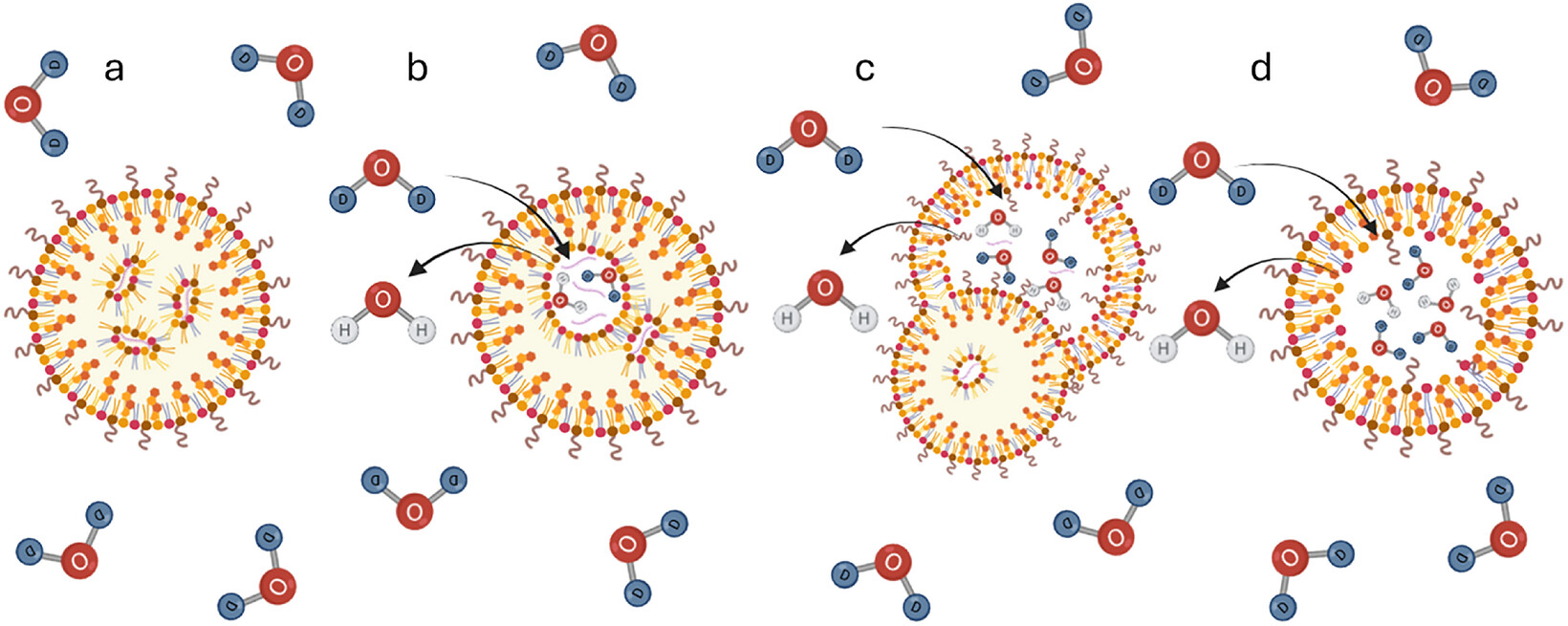
Schematic drawing of D2O and H2O exchange between solvent and water-loaded cavities in lipid-based particles when (a) no detectable solvent exchange occurs in compact mRNA-LNPs, while D2O enters water-loaded cavities in (b,c) phase-separated mRNA-LNPs and (d) liposomes. Created in BioRender. Mehn, D. (2026). Https://BioRender.com/cmynnhs.
“Particles that appear similar in size can still be very different internally,” says Dora Mehn. “By looking at how they behave in liquids of different densities, we can obtain information about particle morphology and identify heterogeneity within an LNP population.”
“Access through NFFA-Europe enabled us to initiate this collaboration, perform analytical ultracentrifugation (AUC) measurements, and exchange expertise on different methodologies to address gaps in the analytical characterisation of mRNA-LNPs. This collaboration has laid the foundation for a long-lasting partnership, which we are now further strengthening through collaborative PhD scholarships with JRC Ispra.” says Prof. Ine Lentacker.
The researchers compared compact particles, liposomes and different types of mRNA-loaded LNPs in several liquid media, including ordinary aqueous buffer, sucrose-containing buffer and a buffer containing heavy water (D₂O). For particles containing internal aqueous compartments, the D₂O-based liquid produced a revealing effect: water from the surrounding liquid can pass through the lipid membrane and exchange with water inside these compartments. This changes the apparent density of the particles and consequently how they move during centrifugation. LNP populations that initially appeared relatively uniform could therefore separate into multiple subpopulations, exposing previously hidden structural heterogeneity.
Cryogenic transmission electron microscopy (cryo-TEM) remains the gold standard for directly visualising differences in LNP morphology. The study shows, however, that AUC can provide a complementary way to detect distinct morphologies, with higher throughput and while studying nanoparticles in liquid, including their native buffer, without the need for freezing.
The approach provides a practical way to compare different LNP populations and monitor changes in their morphology over time or under different conditions. This opens possibilities for using AUC to assess batch homogeneity and investigate particle stability and the effects of different storage conditions. More broadly, the method adds a complementary tool for characterising the internal structure of LNPs, supporting the development and optimisation of future mRNA-LNP formulations.
D. Mehn, M. Hugo Silva, R. Verbeke, A. Peletta, M. H. Y. Cheng, S. C. De Smedt, S. L. Appleton, A. Sarracino, J. Ponti, L. Calzolai and I. Lentacker, “Analytical Ultracentrifugation in Different High-Density Media Allows to Assess Heterogeneity of mRNA-Lipid Nanoparticles,” Small Methods, 2026.
DOI: 10.1002/smtd.202502420
The study received part of its funding through NFFA-Europe, proposal ID725, and involved experiments/measurements/etc. with analytical ultra centrifuge and HPLC with CAD, UV and Fluorescence detectors at JRC - ISPRA.

Ine Lentacker is currently a Full Professor at Ghent University and Principal Investigator of the ‘Vaccine Delivery Group’ within the Laboratory of General Biochemistry and Physical Pharmacy (www.drugdelivery.be). Her research focuses on the design, characterization, and clinical translation of innovative mRNA-based vaccines and immunotherapies. She serves as co‑coordinator of the European Horizon 2020 project Baxerna2.0, which advances the development of bacterial mRNA vaccines. In parallel, she leads a CEPI-funded project aimed at elucidating the impact of freeze‑drying on mRNA vaccine stability and performance using state‑of‑the‑art analytical methodologies. Her work has contributed to the establishment of the Nanomedicine Center (www.Nanomedicinecentre.com), which fosters collaboration with the GMP facility at UZ Gent for the production of mRNA vaccines for phase I clinical studies, including the patented mRNA Galsome platform developed within her team. Recently, she was awarded an ERC Consolidator Grant (My‑NANO) to investigate fundamental interactions between mRNA therapeutics and the innate immune system, with the goal of designing a new generation of immunotherapies for solid tumors
PI CONTACT DETAILS
Prof. Ine Lentacker, Ghent Research Group on Nanomedicines, Faculty of Pharmaceutical Sciences, Ghent University, Ottergemsesteenweg 460, Ghent, Belgium.

